Symmetry is one of those things everyone agrees looks good. It’s clean, balanced, predictable. It’s basically math’s version of “everything is where you expect it to be.”
And that’s exactly the problem when you’re the one building it.
When something is symmetric, every mistake gets duplicated.
Miss a point on one side? Congrats, now the whole shape looks wrong on both sides.
With asymmetric shapes, small imperfections can hide. In symmetric ones, precision suddenly becomes non-negotiable.
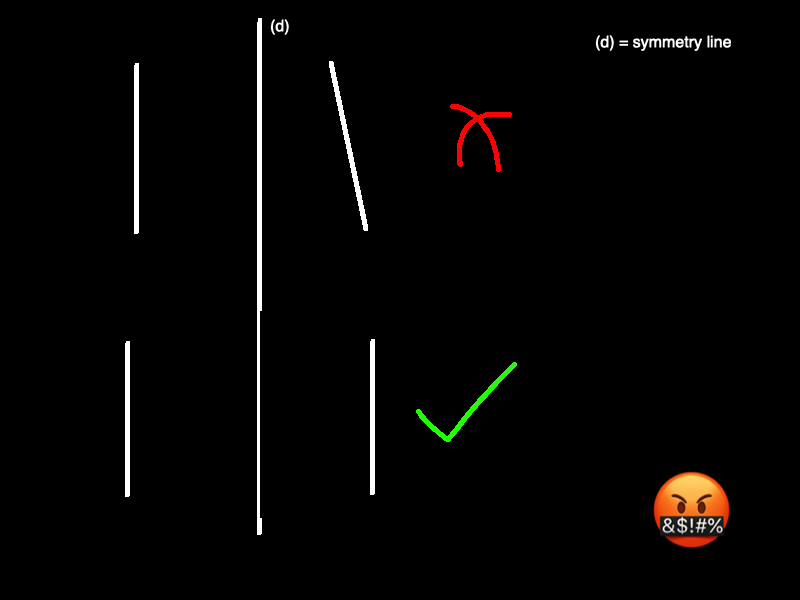
Building symmetric shapes feels less like designing and more like copying yourself in real time.
You make one side… and then you’re forced to replicate it exactly. At that point, you’re not really creating anymore—you’re just mirroring.
It’s like drawing with one hand tied to a photocopier.
You’re constantly tracking distances, angles, alignment, and whether each point actually matches its counterpart.
Instead of flowing with the design, your brain turns into a geometry debugger.
On paper, symmetry is perfect.
In real life—whether it’s drawing, coding, or modeling—tiny errors accumulate fast. Rounding issues, shaky lines, or slight misplacements all break the illusion.
You end up spending more time fixing symmetry than enjoying the process.
Asymmetry gives room for variation, surprise, and organic structure.
Symmetry feels like control. Asymmetry feels like something evolving on its own.